
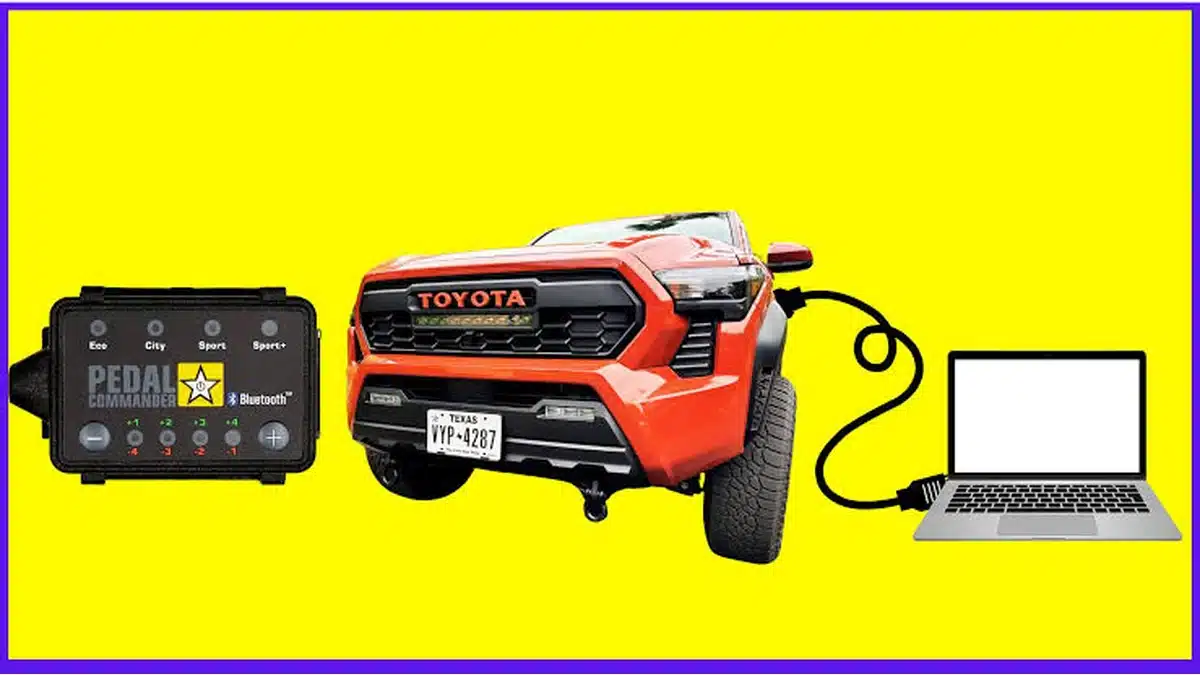
Your Tacoma does not need to be a race truck for its factory throttle mapping and transmission logic to get old. That delayed pedal response, the downshift that arrives late, and the constant gear hunting on grades can make an otherwise capable Toyota or Lexus feel flat. The ECU tune versus piggyback decision matters because the two approaches change your vehicle in very different ways.
For most naturally aspirated Toyota and Lexus truck and SUV owners, the goal is not a flashy dyno number. It is a truck that responds when you ask, holds a gear when it should, and feels more predictable with larger tires, camping gear, a trailer, or a long hill ahead.
What an ECU Tune Actually Changes
An ECU tune changes the calibration inside the vehicle’s engine computer. Depending on the platform and tuning solution, that can include throttle mapping, torque management, fueling, ignition strategy, speed limiter settings, cooling fan behavior, and other engine operating parameters. When transmission calibration is part of the package, it can also address shift timing, shift firmness, torque converter behavior, and the logic that decides when to hunt for another gear.
That direct access is the biggest difference. A properly developed ECU calibration tells the truck’s computer to behave differently at the source. It is not trying to convince the computer that a sensor is reading something else.
For Toyota and Lexus owners, that matters because many of the daily-driving complaints are calibration complaints. A stock 4Runner, Tacoma, Tundra, GX, or FJ Cruiser may have plenty of usable capability, but factory programming is built around broad operating conditions, emissions requirements, conservative torque management, and a driver who may never tow or run oversized tires. The result can feel overly cautious.
A platform-specific tune can make pedal input more linear and useful. Instead of pressing deeper into the pedal before the truck reacts, you get a more connected response. On vehicles with supported transmission tuning, the improvement can be even more noticeable: fewer unnecessary shifts, steadier behavior on rolling roads, and less of that indecisive back-and-forth when the vehicle is loaded.
What a Piggyback Does Differently
A piggyback module is an external device installed between certain sensors and the factory ECU, or connected through a vehicle-specific harness. Rather than rewriting the ECU’s calibration, it intercepts or modifies signals the ECU sees. The ECU then responds based on that altered information.
Piggybacks are common in forced-induction applications because they can be a practical way to influence fueling or boost-related behavior without directly flashing the factory computer. They can also appeal to owners who want a removable device or who are working with a platform where direct ECU tuning is limited.
That does not make every piggyback a bad choice. It simply means it is a different tool. On a supercharged build, a turbo setup, or a project with a specific supporting hardware package, a quality piggyback may have a legitimate role. The right answer depends on the vehicle, the modifications, and who is responsible for the full calibration strategy.
For a mostly stock Toyota or Lexus truck owner chasing better street manners, though, a piggyback can be more device than solution. It may improve one part of the driving experience while leaving factory throttle logic and transmission behavior largely untouched.
ECU Tune Versus Piggyback: The Real-World Difference
The cleanest way to think about an ECU tune versus piggyback is direct control versus signal manipulation. An ECU tune changes the instructions. A piggyback works around the instructions by changing the information the computer receives.
That difference shows up behind the wheel. If your biggest frustration is a lazy pedal, an ECU tune can reshape how the throttle request is interpreted. If your truck drops gears too eagerly or searches for gears while towing, engine calibration alone may not be enough – transmission tuning is where the bigger drivability win often lives. A piggyback generally is not the best answer for that kind of transmission behavior.
There is also the question of consistency. Modern engine management systems are designed to monitor inputs, adapt, and protect the drivetrain. When a piggyback modifies sensor data, the factory ECU is still trying to make decisions around a picture that may not perfectly reflect actual operating conditions. With a well-built direct tune, the calibration changes are made with the ECU’s strategies in mind.
Neither route should be treated as a shortcut. Bad tuning is bad tuning, whether it comes in a flash file or a box under the hood. The vehicle needs the right calibration for its exact platform, fuel quality, modifications, and intended use.
When an ECU Tune Makes More Sense
An ECU tune is usually the stronger choice for the Toyota and Lexus owner who wants a more satisfying vehicle every day. That includes the Tacoma owner who is tired of delayed throttle response, the 4Runner owner running larger tires, the GX owner building an overland rig, or the Tundra owner who wants more confidence pulling a trailer.
It is especially compelling when the tune addresses both engine and transmission behavior. Better throttle response feels good immediately, but better shift logic is what can make a truck feel settled. You notice it merging onto the highway, climbing a grade, rolling through town, and driving home after a weekend with extra weight in the back.
An ECU tune also makes sense when you want a solution built around the way Toyota and Lexus platforms actually drive. Generic performance claims are easy to make. The useful question is whether the calibration improves the parts of the experience you deal with every mile.
Kentucky Truck Tuning focuses on those practical gains through Toyota and Lexus-specific calibration work, including authorized Overland Tailor Tuning solutions for supported vehicles. The aim is not to turn your daily driver into something temperamental. It is to make it feel like the capable truck or SUV it should have been from the factory.
When a Piggyback May Be the Better Fit
A piggyback deserves consideration when the vehicle has hardware that requires it, particularly on certain boosted applications. Some builds use proven piggyback systems with established maps, specific injector setups, and supporting fuel or intake modifications. In those cases, the module may be part of a complete package rather than a random add-on.
A removable setup can also appeal to some owners. Still, removability should not be the only deciding factor. You need to know what the module changes, what safeguards remain active, whether it is compatible with your specific model year, and whether it creates compromises you are willing to accept.
Be cautious with products marketed as simple plug-in horsepower. A throttle controller, for example, can change pedal sensitivity but does not create power or recalibrate transmission behavior. It can make the pedal feel sharper, which some drivers enjoy, but it is not the same thing as an ECU tune or a properly configured piggyback.
Questions to Ask Before You Choose
Start with the complaint, not the product. If the truck feels slow to respond, ask whether you want a different pedal map or more actual output. If it gear hunts while towing, ask whether your transmission calibration is supported. If you have added a supercharger, ask what tuning approach has been validated for that exact hardware combination.
You should also be honest about how you use the vehicle. A stock commuter with occasional trail duty needs something different from a heavily modified overland build or a dedicated forced-induction project. Tire size, gear ratio, trailer weight, fuel octane, elevation, and maintenance condition all belong in the conversation.
Finally, ask about support and expectations. A good tuner should explain what the calibration is designed to improve and what it will not fix. A tune will not repair worn plugs, a slipping transmission, clogged injectors, or a mechanical issue hiding behind a drivability complaint.
Your Toyota or Lexus should feel composed when the road gets steep, the cargo gets heavy, or the trail gets slow and technical. Choose the tuning path that solves the problem you actually have, then let the truck do what it was built to do.