
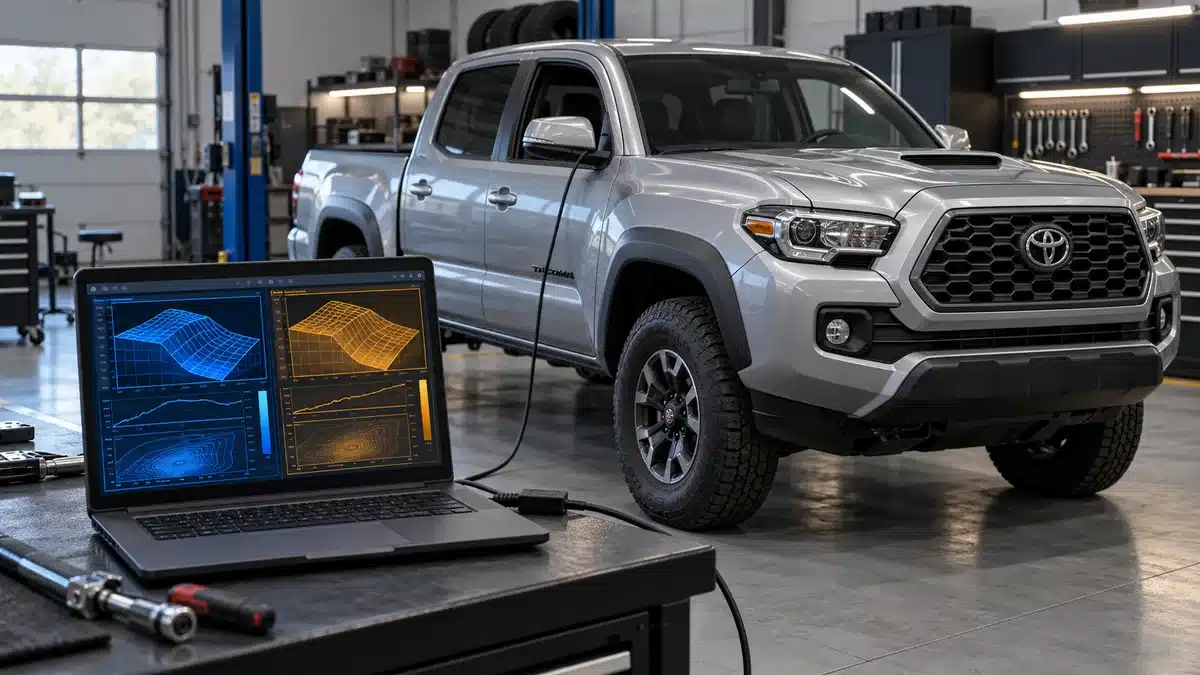
Your Tacoma should not need a floorboard-sized throttle input just to pull into traffic. Your 4Runner should not feel confused about whether it wants fourth, fifth, or sixth on every rolling grade. That is the real Toyota tune vs factory calibration conversation: not chasing a dyno-sheet number, but fixing the parts of the driving experience you deal with every day.
For Toyota and Lexus truck and SUV owners, the factory calibration is dependable and conservative by design. A platform-specific tune can make the same vehicle feel more awake, more predictable, and better matched to the way it is actually used – commuting, towing, hauling gear, climbing trails, or running larger tires.
Why Factory Calibration Feels So Conservative
Toyota has to build one calibration for a huge range of drivers, climates, elevations, fuel quality, vehicle loads, and regulatory requirements. The same Tacoma may spend its life crawling through city traffic, towing a trailer through Kentucky hills, or running unloaded on the interstate in Arizona. Factory programming has to account for all of it.
That broad approach comes with compromises. Throttle mapping is often soft at low pedal input. Transmission logic may upshift early for fuel economy, then downshift aggressively when the vehicle sees a hill or a little extra throttle. The result is the familiar surge, delay, and gear hunting that frustrates so many owners.
None of that means the vehicle is broken. It means the stock calibration is built to be safe, repeatable, and acceptable to the widest possible audience. It is not built around your tire size, your trailer, your terrain, or your right foot.
Toyota Tune vs Factory Calibration: The Real Differences
A quality Toyota-specific tune changes the vehicle’s control strategy rather than simply adding a dramatic number to an advertisement. The goal is a truck or SUV that responds naturally when you ask it to move and holds a gear when it should.
Throttle Response That Matches Your Foot
Factory throttle mapping can make early pedal travel feel lazy, especially on naturally aspirated Toyota V6 and V8 platforms. You press farther, wait for the vehicle to react, then add even more pedal. When the response finally arrives, it can feel abrupt.
A custom calibration can make that relationship more direct. It does not magically create displacement or turn a 4Runner into a race truck. It makes normal pedal input produce a more useful, more predictable response. Pulling into traffic, passing on a two-lane road, and getting a loaded rig moving from a stop all feel less like a negotiation.
For off-road drivers, controlled response matters as much as quick response. A tune should be smooth enough to meter power cleanly over loose terrain, rocks, or a rough trail instead of feeling touchy and jumpy.
Transmission Behavior Is Usually the Big Win
For many owners, transmission tuning is where the difference becomes obvious. Stock shift logic often chases the highest possible gear. On flat ground, that may be fine. Add a grade, headwind, roof rack, camping load, larger tires, or a trailer, and the transmission starts searching.
A tune can revise shift timing, converter behavior, and downshift logic so the transmission holds useful gears longer and makes fewer unnecessary shifts. The truck stays settled instead of bouncing between ratios. That means less noise, less frustration, and better control when the road is not perfectly flat.
It also changes how the vehicle feels under load. Rather than waiting until you are deep into the throttle before it reacts, a properly calibrated transmission can respond with more intention. You are not constantly working around the programming to keep momentum.
Larger Tires Change More Than the Look
A lift and larger tires can be the point where stock behavior goes from mildly annoying to hard to ignore. Bigger, heavier tires effectively change the load the drivetrain sees. Acceleration can feel softer, shift behavior can get busier, and the engine may spend more time outside its useful power range.
Calibration cannot replace proper gearing when a build is pushed far enough. If you have moved to a major tire size increase, re-gearing may still be the right mechanical answer. But tune support for modified gear ratios and tire-related changes can help the engine and transmission work together more effectively.
That is why generic tuning is a poor fit for these vehicles. A Tacoma on 33s, a GX 460 with overland weight, and a stock-height Tundra used for towing do not need the same driving strategy, even if all three owners want better response.
What a Tune Will Not Do
Straight talk matters here. A tune will not fix a mechanical issue, worn transmission components, bad sensors, poor maintenance, or a cooling system problem. If the vehicle has a check-engine light, harsh mechanical shifting, slipping, or an unresolved drivability fault, diagnose that first.
It also will not turn every Toyota into a high-horsepower build. The most meaningful benefit on many Toyota and Lexus trucks is the way the vehicle delivers the power it already has. Better pedal response and smarter shifting can make a rig feel significantly stronger in real driving without making wild claims.
Fuel economy is another depends-on-your-foot question. A calibration may reduce unnecessary hunting and help the engine operate more sensibly under certain conditions. But sharper response can also tempt you to use more throttle. Expect better drivability first. Treat any mileage change as vehicle- and driver-specific.
Is Factory Calibration Ever the Better Choice?
Absolutely. If you are happy with how your truck drives, rarely tow, run stock tires, and prefer to leave every system exactly as delivered, factory calibration is a valid choice. Toyota’s programming has a long track record of reliability, and not every owner needs a change.
Owners with warranty concerns should also make an informed decision before modifying calibration. Dealer software updates can overwrite aftermarket programming, and warranty outcomes can vary by situation, dealer, and repair. Ask questions, keep records, and work with a shop that understands the platform instead of treating your truck like a generic flash job.
The case for tuning gets stronger when the stock behavior is actively getting in the way. If your SUV hunts gears on grades, your Tacoma feels delayed from a stop, or your Tundra gets unsettled with a trailer behind it, that is not something you have to simply accept as the price of ownership.
Choosing the Right Toyota and Lexus Tune
The best tune is not necessarily the one making the biggest promise. Look for one developed around Toyota and Lexus engine and transmission behavior, with options that fit your exact model, year, drivetrain, modifications, and intended use. A daily-driven GX needs a different feel than a dedicated trail 4Runner or a work-focused Tundra.
Talk through how you use the vehicle. Mention tire size, gear ratio, trailer weight, armor, roof load, and whether you value relaxed highway manners, passing response, trail control, or all of the above. Those details are not side notes. They are what turn a calibration from a generic improvement into one that fits the truck.
Kentucky Truck Tuning works with Toyota and Lexus owners who are tired of adapting their driving style to stock programming. As an authorized Overland Tailor Tuning retailer, the focus is on the stuff you can feel from the driver’s seat: cleaner throttle response, less gear hunting, smoother pull under load, and a vehicle that behaves like it should have from the start.
The Better Question to Ask
Instead of asking whether a tune makes more power, ask whether your truck does what you need it to do without drama. Does it respond when you merge? Does it hold a gear while towing? Does it stay composed on hills and with added weight? Can you drive it off-road without fighting a numb pedal or awkward shifts?
Factory calibration is built for everyone. The right Toyota or Lexus tune is built around how you use your rig. When the truck finally feels connected to your inputs, every drive – from the grocery run to a loaded weekend out of town – gets better.